
In September 2026, the Ministry of Industry and Information Technology and nine other departments jointly issued the "15th Five-Year Plan" for the Development of the Pharmaceutical Industry (hereinafter referred to as the "Plan"), drawing a clear roadmap for the high-quality development of China's pharmaceutical industry over the next five years. Among numerous key plans and cultivation scenarios, "AI" has become an absolutely high-frequency term.
In the chapter "Deepening AI-Empowered Upgrading," the Plan explicitly proposes to "accelerate the development of pharmaceutical vertical large models and intelligent agents, focus on drug discovery, clinical research and other links to create high-value AI pharmaceutical application scenarios, and accelerate the paradigm transformation of AI-driven pharmaceutical R&D and production management."
Regarding the "cultivation of high-value AI pharmaceutical application scenarios," the Plan clearly states that it is necessary to "focus on developing application scenarios such as AI-empowered target screening, drug molecule design and optimization, and assisted clinical trial protocol review and scientific evaluation."
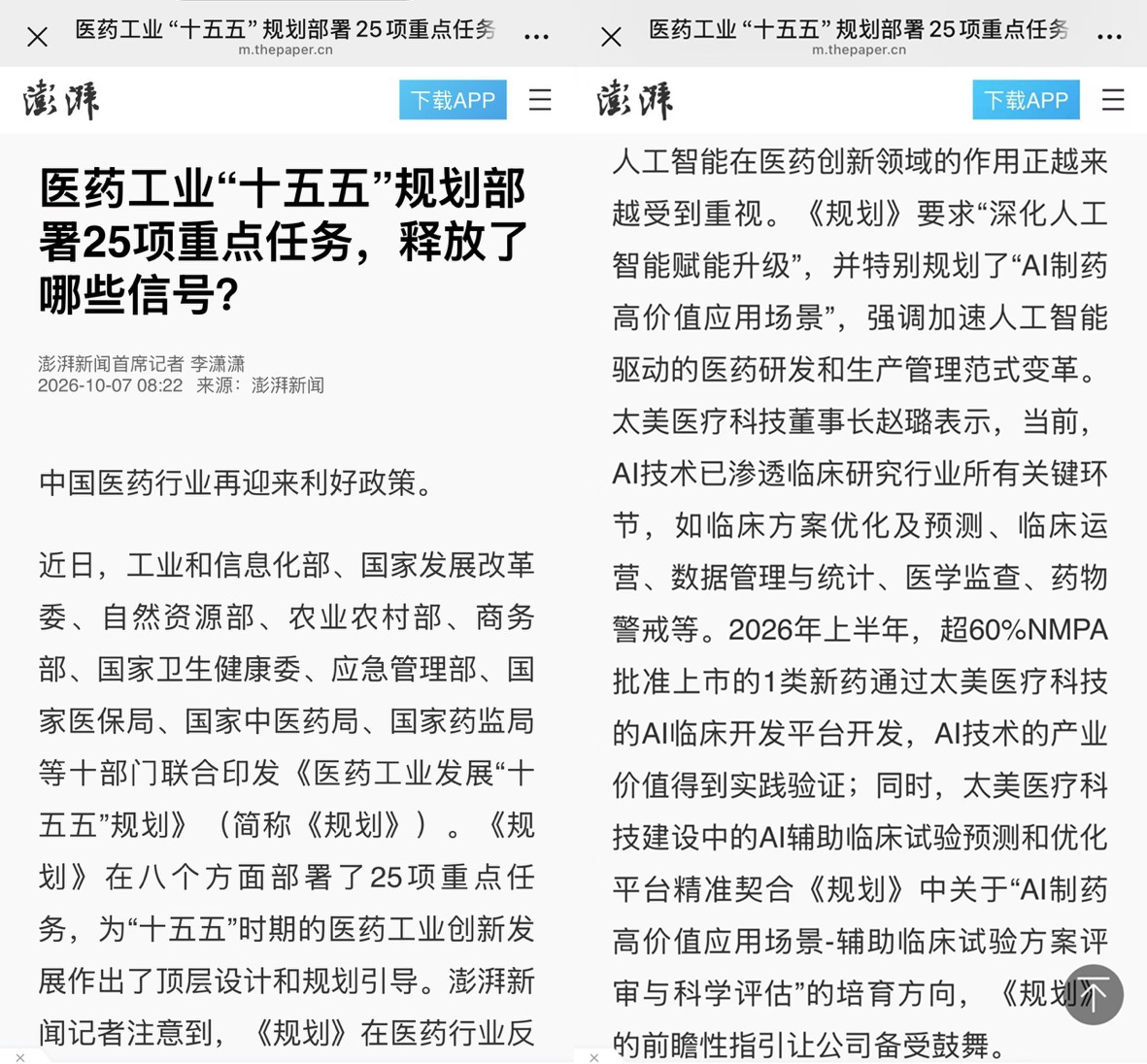
On October 7,澎湃 News published a feature article titled "The 15th Five-Year Plan for the Pharmaceutical Industry Deploys 25 Key Tasks: What Signals Are Released?", interpreting the significance of the Plan.
In an interview with Taimei Technology, Zhao Lu, Chairman of the company, stated: Currently, AI technology has penetrated all key links of the clinical research industry, such as clinical protocol optimization and prediction, clinical operations, data management and statistics, medical monitoring, and pharmacovigilance. In the first half of 2026, more than 60% of Class 1 new drugs approved by the NMPA for marketing were developed through Taimei Technology's AI clinical development platform, validating the industrial value of AI technology in practice. At the same time, the AI-assisted clinical trial prediction and optimization platform under construction by Taimei Technology precisely aligns with the cultivation direction of "high-value AI pharmaceutical application scenarios—assisted clinical trial protocol review and scientific evaluation" in the Plan. The forward-looking guidance of the Plan greatly encourages the company.
How exactly will artificial intelligence reshape drug discovery and clinical trials? As China's pharmaceutical industry shifts from scale expansion to quality leap, and as China's role in the global pharmaceutical innovation system shifts from "user of outcomes" to "important contributor," what assistance will Taimei Technology's AI clinical development platform provide for the development of China's innovative drugs?
Building a Path to High-Quality Pharmaceutical Development with AI Clinical Development Capabilities
The Plan sets numerous development goals for China's pharmaceutical industry by 2030: biopharmaceutical R&D and application remain at the forefront globally, innovation-driven efficiency is fully unleashed, and systematic breakthroughs are achieved in key core technologies in key fields. In terms of specific indicators, the average R&D investment intensity of listed pharmaceutical companies reaches an annual average of over 10%, the global share of first-in-class (FIC) drugs exceeds 25%, and the number of R&D pipelines for new drugs initiating clinical trials for the first time and the number of marketed innovative drugs rank among the world's forefront.
The AI clinical development platform, which has grown based on real industry needs, deep industry accumulation, and a solid data foundation, is becoming the most solid industry infrastructure in the new wave of pharmaceutical innovation and upgrading.
Taking AI for Productivity, the most closely watched area at the current stage, as an example: the iDM data management intelligent agent can increase database building efficiency by 80%, the iCTA document management intelligent agent reduces attribute filling time by 70%, and the iPV pharmacovigilance intelligent agent processes 1,000 reports at only one-third the cost of the traditional manual model. Every efficiency improvement accumulates advantages for fierce competition in the same target.
More importantly, AI clinical development is not a simple stacking of Agents, but holistic empowerment throughout the entire clinical development chain, truly embedding "AI for Success" throughout clinical research.
In the design stage, AI can solve the optimization challenge of billion-level parameter combinations in trial design; in the execution stage, algorithms calculate optimal dosages, break down information barriers between patients and trials, and simultaneously conduct natural history studies for rare diseases where most have no available drugs; in the data analysis stage, automated processes can increase data management efficiency by 40%–50% and predict sample and endpoint timing in advance; in regulatory submission, AI can assist in generating submission documents and their tables of contents.
Success Begins with Clinical Trial Protocol Prediction and Optimization
Statistics show that the probability of success for an innovative drug from entering Phase 1 clinical trials to final marketing approval is less than 10%, and the success rate in the oncology field is even less than 5%. How to improve pipeline screening from the source and increase the success rate of clinical trials is the most critical challenge for innovative pharmaceutical companies.
Dr. Chen Jie, Chief Scientific Officer of Taimei Technology, stated that most clinical trial failures usually stem from unreasonable protocol design, difficulty in patient recruitment, flawed statistical plans, and clinical evidence not meeting regulatory requirements. Especially in the most core major decisions such as pipeline selection and clinical trial design, decision-makers often rely heavily on past experience, expert scoring, or simple model reasoning. The decision granularity is large, the process is opaque, there are many subjective assertions, and interpretability is poor; facing increasingly complex clinical trial design and evaluation factors today, it is often difficult to make optimal decisions.
Currently, Taimei Technology is building an AI-assisted clinical trial prediction and optimization platform. This framework addresses the increasingly complex protocol design and evaluation factors of modern clinical trials by integrating multi-source, multimodal structured/unstructured data, such as drug mechanisms of action, safety profiles, biomarkers, design parameters, competitor data, and regulatory requirements, and repeatedly conducting prediction and optimization for a specific drug-disease combination until the success rate reaches the optimum.
At present, this AI prediction framework has been implemented in Taimei Technology's innovative drug rights evaluation platform, participating in the screening and evaluation of nearly 100 innovative drug pipelines, and is about to realize the translational application of cutting-edge technology from theoretical research to industrial implementation.
"AI for Success" is Taimei Technology's unwavering philosophy. Looking ahead, Taimei Technology will continue to iterate the Wiz.AI Wensi Intelligent Platform and AI Agent matrix, continuously output mature, compliant, and scalable intelligent clinical development tools, help global partners continuously improve innovation efficiency and quality, and jointly promote global pharmaceutical innovation.