
As million-token context windows become standard in mainstream models, and Claude Code and Workbuddy become startup items on more and more computers, AI Agents and even AI clinical development platforms in the clinical development field are moving beyond observation and entering a phase of controllable implementation and tangible value creation. How to quickly secure a position in this wave of AI has become a source of anxiety for many pharmaceutical companies.
At the recently held 2026 Digital Intelligence Clinical Summit, Lu Yiming, Global Head of Product and Research at Taimei Technology, shared insights on building enterprise-level clinical AI platforms. From the challenges of implementing enterprise AI strategy, setting business objectives, selecting entry scenarios, and building the platform to establishing organizational confidence, and combined with the implementation practices of the Wiz.AI platform in multiple large enterprises, he clearly outlined for pharmaceutical companies the AI evolution path from point validation to organization-level implementation.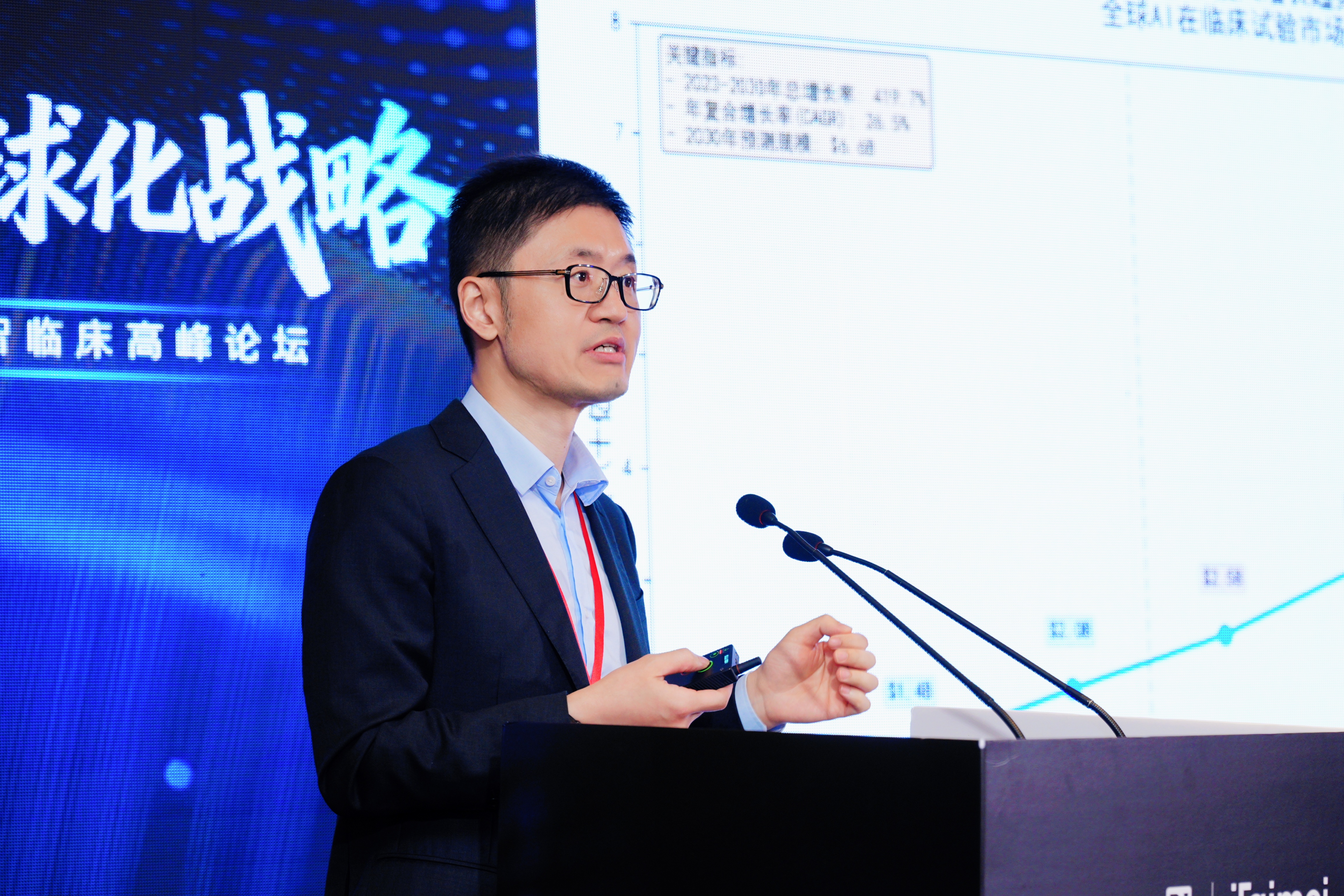
Lu Yiming, Global Head of Product and Research at Taimei Technology
First Step to Resolve AI Anxiety: Clarify Strategic Objectives
In the AI wave, enterprises are eager to pursue intelligent transformation, yet repeated attempts that are difficult to scale are a common phenomenon.
Lu Yiming stated: Strategy, data, and talent are common challenges in intelligent transformation. In some AI implementation pilots, unclear strategy leads to confusion about the inability to generate substantive financial value, the lack of a high-quality data foundation prolongs the AI implementation cycle, and the shortage of AI composite talent makes organizational change difficult—all of these are realistic problems.
To address these issues, he suggested that the scaled implementation of AI technology should start with high-certainty, verifiable scenarios, such as data management and pharmacovigilance—business modules with clear requirements, clear metrics, and quantifiability—to continuously build organizational confidence, create an integrated clinical data platform, and establish a trusted data foundation. Then, gradually expand to scientific and decision-making scenarios such as protocol design and registration strategy, progressively driving the construction of intelligent platforms and organizational process transformation, ultimately making AI a reliable productivity partner in enterprise clinical development.
He noted that the phased goal of intelligent clinical development is to free up expert time and improve the quality of operational and scientific decision-making. The ultimate goal is to shorten timelines, reduce risks, and improve success rates. The key is not deploying large models or implementing a single Agent, but rather, on the basis of a clear understanding of the value of AI technology, business objectives, data accumulation, and talent reserves, using AI, embracing AI, and completing the transformation of enterprise organizational structures to welcome the arrival of intelligence.
"Whether from regulatory guidance or objective reality, the intelligentization of clinical development is an inevitable trend. We should not approach it with a pilot mindset; rather, we should validate AI with the rigor of clinical research, rapidly accumulate experience, and accelerate the construction of clinical development AI platforms."
Wiz.AI Wensi Intelligent Platform Implementation Case Sharing
The Wiz.AI Wensi Intelligent Platform was independently developed by Taimei Technology and has now established an AI agent matrix covering the entire clinical development lifecycle, including clinical protocol optimization and prediction, clinical operations, data management, statistics and programming, medical monitoring, endpoint assessment, pharmacovigilance, and all other key stages.
In his speech, Lu Yiming shared two classic scenarios of the Wiz.AI Wensi Intelligent Platform in document processing and data management.
1. From Validation to Large-Scale Implementation—iCTA (AI TMF) Reduces Document Processing Time by 70%
The iCTA Trial Master File management agent enables full-process AI empowerment in TMF management, from file collection, classification, and naming to quality control. In actual project implementation, iCTA can reduce document processing time by approximately 70%, achieve over 90% accuracy in automatic naming and metadata extraction, and rapidly enable comprehensive internal enterprise application after processes such as multi-department validation, standardized packaging, and SOP updates.
2. AI-Driven Progressive DM Process Transformation—iDM Promotes Organizational Structure Upgrade
The iDM data management agent achieves a high degree of automation and even intelligence in stages ranging from protocol interpretation, eCRF design, data collection and cleaning, to data review and automated testing. In project implementation, iDM generation can reduce use case generation and testing time by approximately 60%, save 50% of manual work hours, and enable the reconstruction of data management processes and the "intelligent transformation" of organizational structures.
At the end of his speech, Lu Yiming emphasized that data governance and security compliance are the foundation for scaled implementation, and enterprises need to establish a unified data asset platform and comply with international standards and regulatory requirements.