
Recently, the National Medical Products Administration issued the "Good Clinical Practice for Drug Clinical Trials (2025 Revised Draft for Comments)" to further standardize the management rules related to clinical trials. Among them, the comprehensive upgrade of risk management requirements is particularly noteworthy.
According to the draft for comments, risk management in clinical research will be elevated from a "marginal auxiliary" to a "core pillar." This change will profoundly affect the daily working models of sponsors, investigators, and even ethics review committees.
Major Upgrade of GCP Risk Management Requirements: From “Principles” to “Detailed Rules”
01. Establishing the Core Position of Risk Management
Article 6 of the 2025 GCP [Trial Design Concept, Risk-Proportionate Principle] clearly stipulates:
"The design and conduct of clinical trials shall incorporate a quality-by-design approach, identify critical quality factors and related risks of the trial, and adopt risk control measures proportionate to them, so as to protect the rights and safety of trial participants and ensure reliable results."
Interpretation: This clause, for the first time, writes the principles of "quality by design" (QbD) and "risk proportionality" into the general provisions, meaning that risk management must be moved forward to the trial design stage. Sponsors need to demonstrate that their trial design has systematically considered risk identification and control measures, rather than supplementing them afterwards.
02. Building a Complete Risk Management System
Compared with the current GCP, Article 42 [Risk Management] of the 2025 GCP provides more detailed provisions on the five key elements of risk management:
(1) Risk identification and assessment:
The sponsor shall identify, before the trial begins and throughout the trial process, risks that may have a meaningful impact on critical quality factors, and assess the likelihood of risk harm, the extent to which it can be detected, and the impact on the protection of trial participants and the reliability of trial results.
(2) Risk control:
Risk control shall be proportionate to the importance of the risk's impact on the rights and safety of trial participants and the reliability of trial results. When critical quality factors that may affect the safety of trial participants or the reliability of trial results are involved, the sponsor shall pre-set an acceptable range for risk control and, when the preset range limit is exceeded, assess whether measures need to be taken.
(3) Risk communication:
The sponsor shall document identified risks and corresponding mitigation measures and communicate them to personnel involved in taking measures or affected by such activities.
(4) Risk review:
The sponsor shall, in light of new knowledge and experience during the clinical trial, regularly review risk control measures to ensure the effectiveness and applicability of current quality management activities.
(5) Risk reporting:
The sponsor shall summarize and report important quality issues in the clinical trial report, including issues deviating from the pre-set acceptable range and remedial measures."
Interpretation: This clause establishes a complete closed-loop risk management system, forming a complete evidence chain from identification to reporting. Particularly noteworthy is the requirement to "pre-set an acceptable range for risk control"—this essentially introduces the concept of quality tolerance limits (QTLs), requiring sponsors to establish quantitative risk monitoring indicators.
03. Innovation in Ethics Review: Application of the Risk-Proportionate Principle
Article 14 (5) [Review of Safety Events] of the 2025 GCP stipulates: "For suspected and unexpected serious adverse reactions reported by the sponsor, as well as development safety update reports during drug development, the ethics review committee shall review them in a manner at least proportionate to the urgency of the measures required and changes in the safety profile of the investigational medicinal product."
Interpretation: This reform completely changes the working model of ethics review. Previously, ethics committees were required to review all SUSAR reports; the new rules allow a review method proportionate to risk, such as reviewing aggregate reports rather than individual cases. This ensures that major risks receive focused attention while significantly reducing the workload of ethics committees.
Addressing the Challenges of New Regulations: eCooperate Risk Management Solution
Taimei Technology's eCooperate (CTMS) updated its risk management module as early as its 2018 upgrade and iteration. Since its launch, through continuous accumulation of experience and improvement, it has provided customers with a complete risk management solution, ensuring that sponsors can efficiently meet regulatory requirements.
01. Multi-dimensional Data Monitoring to Identify Key Risk Factors
Target clause: Article 42 (1) "Identify critical quality risk factors throughout the trial process"
eCooperate (CTMS) solution:
Through built-in risk data models and multi-source system integration capabilities, the system synchronizes with multi-source data such as eCollect (EDC), eOutcome (eCOA), and eArchives (eTMF), providing a real-time and accurate data foundation for risk identification at each stage of the trial, building a risk monitoring network covering the entire trial process, and realizing the transformation of risk identification mode from "experience-driven" to "data-driven."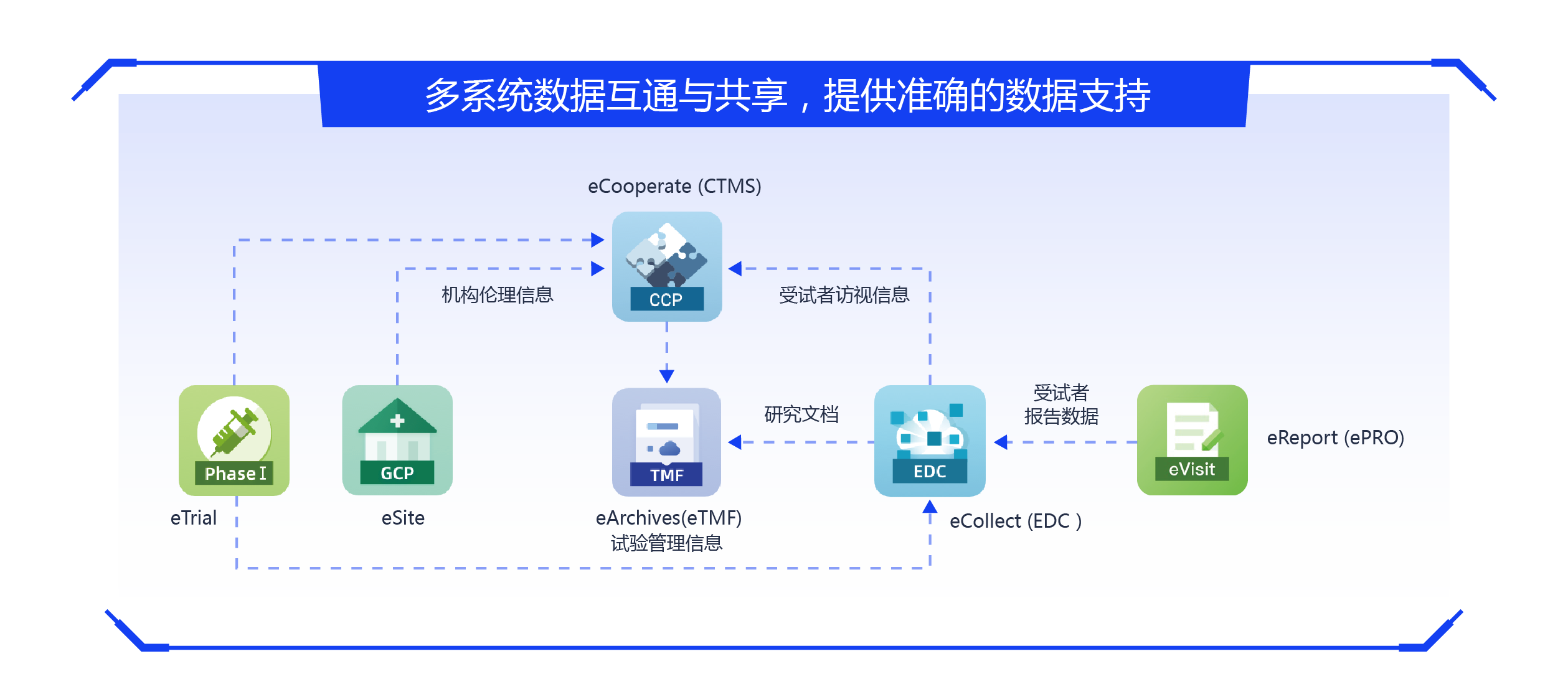
02. Risk Threshold Configuration
Target clause: Article 42 (2) "Pre-set an acceptable range for risk control"
eCooperate (CTMS) solution:
Taimei Technology's eCooperate (CTMS) system supports project administrators in customizing risk thresholds according to trial characteristics. For example, "PD incidence higher than 30%" can be set as high-risk status, "10%-20%" as medium risk, and "lower than 10%" as low risk. This quantitative threshold management directly meets the regulatory requirement to "pre-set an acceptable range" and provides a data foundation for risk-proportionate management.
03. Risk Matrix Visualization
Target clause: Article 42 (1) "Identify risks that may have a meaningful impact on critical quality factors"
eCooperate (CTMS) solution:
Through a visual risk matrix chart, the system intuitively displays the risk status of each site in red, yellow, and green. The horizontal axis is the site name, and the vertical axis is various risk indicators, helping management personnel quickly identify sites and problem types requiring priority intervention and enabling early identification and precise positioning of risks.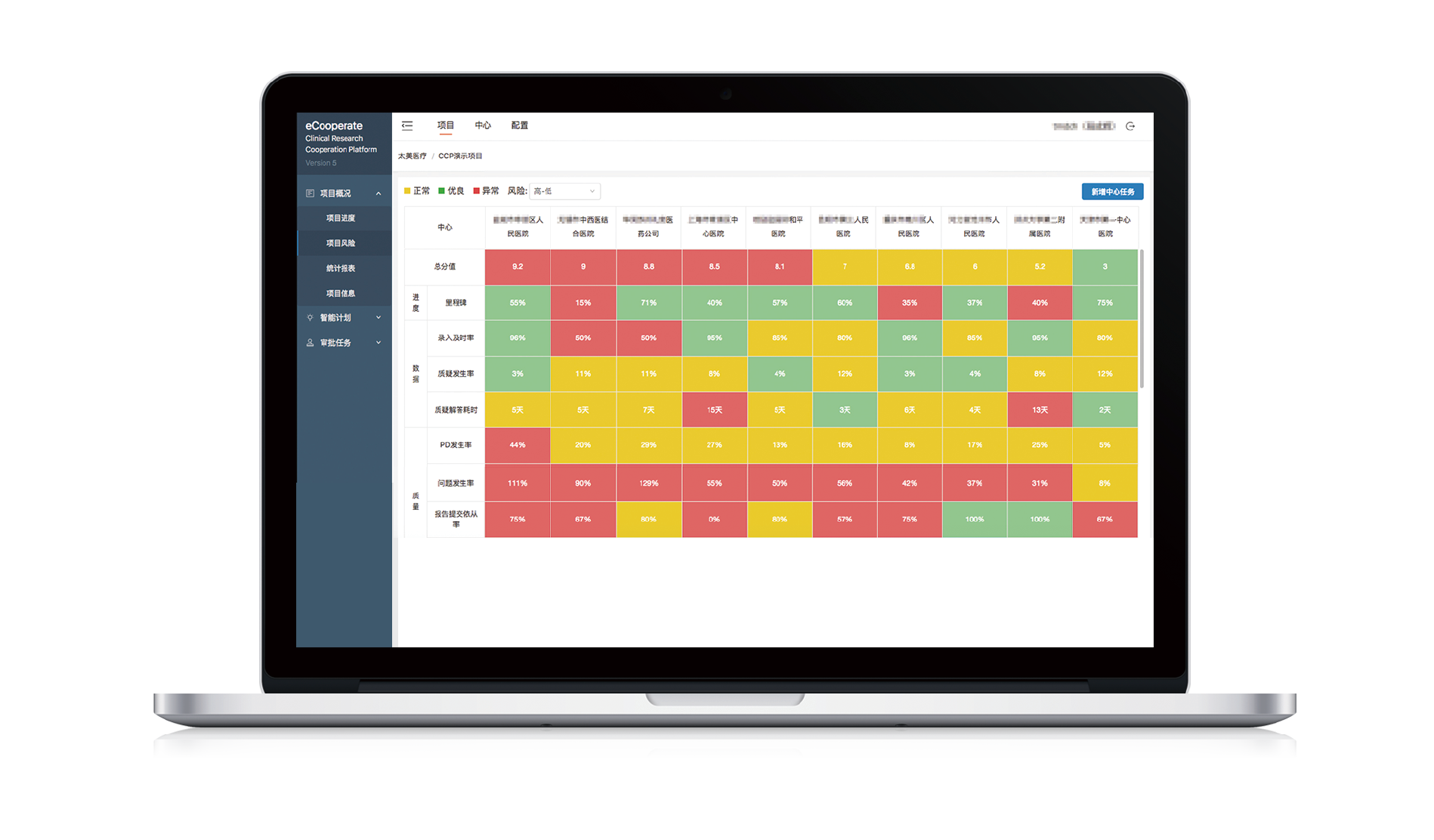
04. Automated Risk Intervention Mechanism
Target clause: Article 42 (3) "Document identified risks and corresponding mitigation measures and communicate them to personnel involved in taking measures or affected by such activities"
eCooperate (CTMS) solution:
When the system detects that a risk exceeds the threshold, it can automatically or manually trigger preset intervention processes, such as generating monitoring plans, to-do tasks, and sending alert notifications. The system records all risk communication records, forming a complete audit trail, ensuring that risk mitigation measures can be promptly communicated to relevant personnel.
Practical Value: A Leap from Compliance to Efficiency Improvement
A domestic innovative pharmaceutical company, when conducting an international multicenter clinical trial and applying Taimei Technology's eCooperate (CTMS) risk management module, achieved:
Compliance level: Systematic risk threshold configuration and documentation enabled the company to demonstrate a complete risk management evidence chain to regulatory authorities and smoothly pass relevant inspections.
Efficiency level: Through risk matrix visualization, the project team concentrated resources on 3 high-risk sites, improving intervention efficiency by 50% and avoiding potential serious quality events.
Cost level: Automated risk monitoring replaced manual spot checks, reducing monitoring costs by 30% while significantly improving the timeliness and accuracy of risk identification.
Outlook: The Future of Intelligent Risk Management
With the implementation of the 2025 GCP, risk management will shift from a compliance action of "meeting regulatory requirements" to a core capability of "improving trial quality." Taimei Technology is applying artificial intelligence algorithms to risk prediction, using learning from historical data to achieve earlier risk warning and more precise intervention recommendations.
The revision of the 2025 GCP marks that China's clinical trial quality management has entered a new stage. Risk management is no longer a bonus question but a mandatory question that determines the success or failure of trials. In this transformation, appropriate tool systems will become a key助力 for sponsors to address the challenges of new regulations and achieve both quality and efficiency improvement.
Taimei Technology's eCooperate (CTMS) system closely aligns with the requirements of the 2025 GCP and provides a full-process risk management solution from risk identification, assessment, and control to reporting, helping sponsors smoothly welcome the implementation of the new regulations. Welcome to inquire for more details on risk management functions.