
Over the past five years, nearly 10% of the 1,492 FDA warning letters issued for drug and device clinical research directly pointed to TMF management deficiencies (TMF, Trial Master File). Based on a systematic analysis of FDA TMF-related warning letters from 2020 to 2025, this article outlines core risks and interprets regulatory signals.
Five-year trend: TMF issues in warning letters have shifted from "occasional" to "frequent," and regulatory focus continues to intensify. Data shows that the proportion of TMF-related issues in FDA warning letters remains high. Notably, in 2024, the number of TMF-related warning letters increased significantly, accounting for 17.6% of the total drug and device development warning letters that year. This may send a strong regulatory signal: FDA scrutiny of TMF is becoming increasingly stringent and detailed.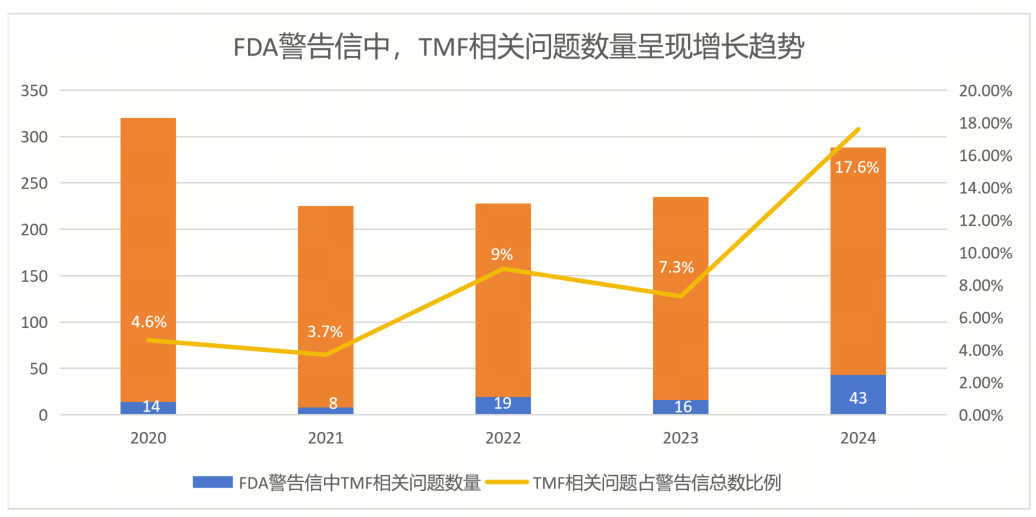
Distribution of core issues: The integrity and quality of the evidence chain are the regulatory focus
After categorizing all TMF issues, it was found that TMF-related problems mainly manifest in five dimensions: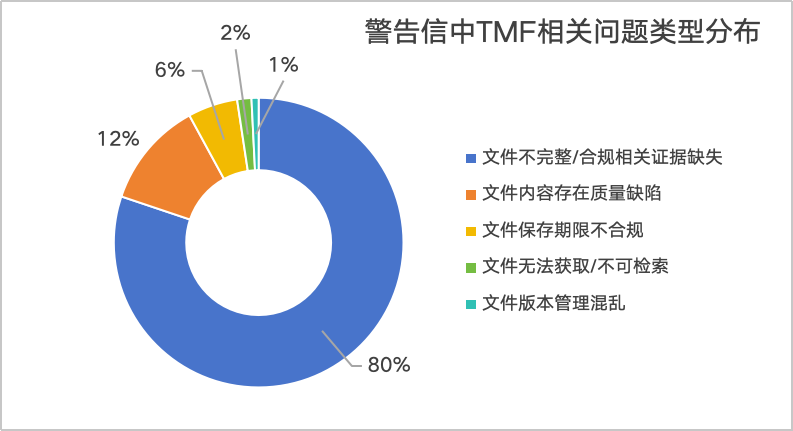
"Existence" dimension:
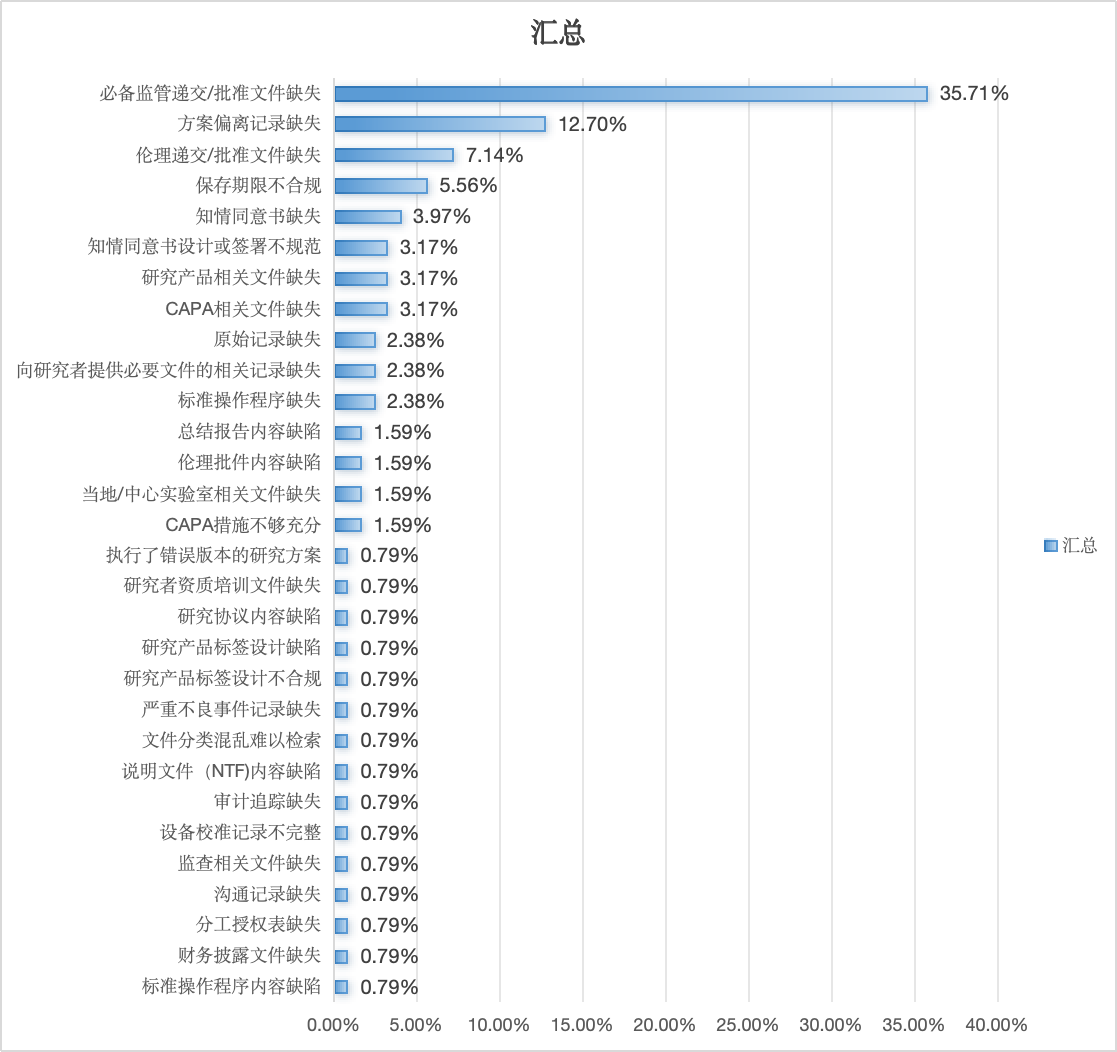
That is, the absence of key process documents. This type of issue, with an overwhelming proportion (about 80%), is the most core risk source. This means that in the vast majority of cases, from the legality of trial conduct to key records of the execution process, there are gaps, and the TMF cannot form a continuous and complete compliance evidence chain. Regulatory concerns about the scientific validity and reliability of trial data and the safety and well-being of participants are reflected in the review of key documents: for example, among the three types of issues with concentrated missing documents, the absence of "required regulatory submission/approval documents" (such as IND approval) directly undermines the scientific regulatory basis of the trial; the absence of "protocol deviation records" affects the assessment of data reliability; and the absence of "ethics submission/approval documents" concerns the fundamental principle of protecting participant rights.
"Accuracy" dimension:
That is, the document content has quality defects. This type of issue accounts for about 12%. Specific manifestations include "defective summary report content," "defective ethics approval content," and "non-compliant design or signing of informed consent forms," etc. This means that even if the document is archived, its core content does not meet regulatory requirements, rendering the document itself non-compliant, reflecting a serious failure in the quality control process for key documents.
"Durability" dimension:
That is, the document retention period is non-compliant. This type of issue accounts for about 6%. This means the sponsor failed to meet the minimum retention period required by regulations, directly undermining the traceability and reliability of clinical research data in long-term regulatory review.
"Retrievability" dimension:
That is, documents cannot be obtained or are not retrievable. This type of issue accounts for about 2%. This means that even if the document exists and its content is compliant, due to a chaotic archiving management system, it cannot be quickly retrieved during a regulatory inspection, rendering the "reconstructability" value of the TMF ineffective in practice.
"Controllability" dimension:
That is, document version management is chaotic. This type of issue accounts for about 1%. It is directly manifested in specific cases such as "executing a wrong version of the study protocol." This means there are multiple uncontrolled document versions in the study, and it cannot be ensured that the final approved version is the one executed, reviewed, and archived, posing a fundamental challenge to the standardization of trial operations and data consistency.
TMF Zone/Section Risk Map: The Focus of Regulatory Review
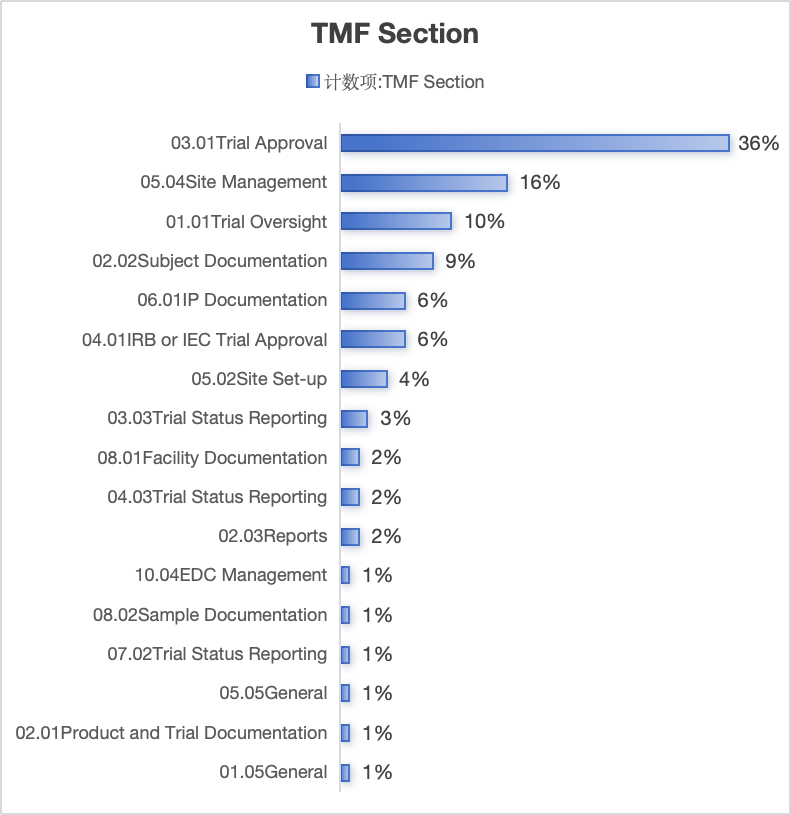
Based on the DIA TMF Reference Model, constructing a risk map of the file zones/sections where these issues are located can clearly help sponsors identify key areas in TMF management. Zone 03 Regulatory-Section 03.01 Trial Approval (Regulatory, 37.50%) and Zone 05 Site Management (20.83%) together account for nearly 60%, making them the absolute risk focus.
In addition, sections 04.01 IRB or IEC Trial Approval, 06.01 IP Documentation, 02.02 Subject Documentation, and 01.01 Trial Oversight also deserve attention. Any missing or uncontrolled management of documents on this critical path will directly lead to a break in the overall compliance evidence chain.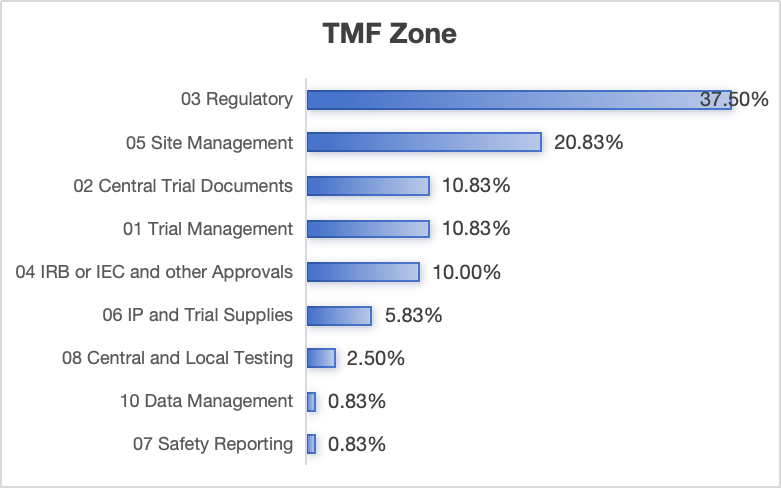
Interpretation of Typical TMF Deficiencies in FDA Warning Letters
1. Missing documents and delayed archiving
This is the most common and most serious deficiency. Data shows that "missing required regulatory submission/approval documents" (such as IND approval letters), "missing protocol deviation records," and "missing ethics submission/approval documents" are the hardest-hit areas for missing documents.
Case warning:
English original: "While in the development stage, such products may be distributed for clinical use in humans only if the sponsor has an investigational new drug application (IND) in effect... null of your products are the subject of an approved biologics license application (BLA), nor is there an IND in effect for any of them."
Chinese translation: 在开发阶段,此类产品仅当申办方持有生效的研究性新药申请(IND)时,方可分发用于人体临床使用。贵公司所有产品均未获得生物制品许可申请(BLA)批准,且未有任何产品持有生效的IND。
Interpretation: In this case, what is missing is not an ordinary document, but the "birth certificate" for conducting clinical research—the IND. This directly rendered all its clinical operations as violations. It warns us that lifecycle management of regulatory approval documents is the bottom line of TMF compliance and allows no errors.
Case warning:
English original: "Subject(b)(6)participated in the study despite meeting exclusion criterion #13 for participation in another clinical trial within 30 days prior to their screening visit. A letter addressed to you dated January 19, 2018, from Cedars-Sinai informed you that this subject completed all study activities in another ALS study on January 15, 2018. However, this document was not located in the subject file, and you did not acknowledge the letter until brought to your attention by the FDA investigator."
Chinese translation: 受试者(b)(6)尽管符合排除标准#13(筛选访视前30天内参与其他临床试验),仍被纳入研究。Cedars-Sinai于2018年1月19日致贵方的信函已告知该受试者于2018年1月15日完成另一项ALS研究的全部活动。但该文件未存放于受试者档案中,且贵方直至FDA检查员指出后才确认该信函。
Interpretation: The absence of this protocol deviation document led to the erroneous inclusion of a subject who did not meet the enrollment criteria, seriously affecting the scientific validity of the study and subject safety. It exposed major loopholes in the information transfer and archiving process from the study site to the sponsor.
2. Quality defects in document content: Compliance in form and substance
Even if a document exists, if its content is non-compliant, it also constitutes a key finding. A typical problem is incomplete informed consent elements.
Case warning:
English original: "Your IRB failed to require that information given to subjects as part of informed consent is in accordance with 21 CFR 50.25 (elements of informed consent). For example: The IRB failed to ensure that IRB-approved informed consent forms (ICFs) ... included a disclosure of appropriate alternative procedures or courses of treatment, if any, that might be advantageous to the subject..."
Chinese translation: 贵机构IRB未要求提供给受试者的知情同意信息符合21 CFR 50.25(知情同意要素)规定。例如:IRB未能确保IRB批准的知情同意书包含对受试者可能有利的适当替代程序或治疗方案的披露..
Interpretation: This points to "quality defects" in document content. TMF management requires not only that documents are "present" but also "correct." There must be strict quality assurance processes for version control and content review of key documents (such as ICFs and protocols).
Case warning:
English original: "Subject(b)(6)participated in the study despite meeting exclusion criterion #13 for participation in another clinical trial within 30 days prior to their screening visit. A letter addressed to you dated January 19, 2018, from Cedars-Sinai informed you that this subject completed all study activities in another ALS study on January 15, 2018. However, this document was not located in the subject file, and you did not acknowledge the letter until brought to your attention by the FDA investigator."
Chinese translation: 受试者(b)(6)尽管符合排除标准#13(筛选访视前30天内参与其他临床试验),仍被纳入研究。Cedars-Sinai于2018年1月19日致贵方的信函已告知该受试者于2018年1月15日完成另一项ALS研究的全部活动。但该文件未存放于受试者档案中,且贵方直至FDA检查员指出后才确认该信函。
Interpretation: The absence of this protocol deviation document led to the erroneous inclusion of a subject who did not meet the enrollment criteria, seriously affecting the scientific validity of the study and subject safety. It exposed major loopholes in the information transfer and archiving process from the study site to the sponsor.
3. Non-compliant document retention periods: The continuity of compliance responsibility
Compliance responsibility does not end when the study ends. Document retention periods are an explicit regulatory requirement.
Case warning:
English original: "You failed to retain records and reports as required for 2 years after a marketing application is approved for the drug; or, if an application is not approved for the drug, until 2 years after shipment and delivery of the drug for investigational use is discontinued and FDA has been so notified... not all complete and contemporaneous source records and reports were available..."
Chinese translation: 贵方未能按照要求保留记录和报告:在药物上市申请获批后保留2年;或若药物未获批,则在停止研究用药的运输和交付并通知FDA后保留2年……并非所有完整且同步的原始记录和报告都可提供。
Interpretation: This case emphasizes that compliant management of document retention periods must be systematic and trackable. Especially when studies are long-term or sponsor structures change, there must be clear archiving and custody strategies.
4. Documents inaccessible/not retrievable: The usability crisis of TMF
Chaotic and unretrievable documents are equivalent to missing documents.
Case warning:
English original: "Your study archives are not organized to permit expedient retrieval. It was observed that records from multiple different studies were stored together in at least 30 boxes without any labels."
Chinese translation: 您的研究档案没有经过整理,无法方便检索。据观察,来自多项不同研究的记录一起存放在至少30个盒子里,没有任何标签。
Interpretation: This is particularly prominent in the paper management era. Regulatory review time is limited, and the inability to quickly retrieve and provide documents is itself regarded as a major deficiency. It highlights the advantages of eTMF electronification and the importance of indexing capabilities.
Trends and implications: A shift in management thinking from "document archiving" to "proving the process"
The essence of TMF:
Data from the past five years clearly show that regulatory expectations have shifted from "whether documents are complete after the study ends" to "whether the evidence chain is real-time, continuous, and credible during the study." As described in ICH E6(R3), "These essential documents facilitate the evaluation of the compliance of the conduct of the clinical trial (i.e., whether the investigator and sponsor comply with this guideline and applicable regulatory requirements) and the reliability of the resulting data." The TMF is essentially a complete mirror of the research activities, a "bridge between regulation and facts."
Deepening of regulatory logic:
The TMF is the "health check report" of the quality system. When a key document is missing, regulators question far more than the document itself; they question the entire management process behind it: Why is the document missing? Did the oversight process fail, or was it never generated? Who should be responsible?
Ultimately, the ultimate regulatory question is: If the research process cannot be reproduced through the TMF, how can the authenticity of the research and the integrity of the data be guaranteed? This "reconstructability" principle is the cornerstone of the FDA's assessment of the credibility of clinical trials.
Responsibility cannot be outsourced:
In multiple cases, even if the problem lies with the CRO or study site, the FDA still holds the sponsor ultimately responsible for oversight. Sponsors must establish and implement effective oversight mechanisms for partners' TMF activities.
TMF compliance risks are real and severe. What is the solution? In the next related article, we will move beyond theoretical discussion and reveal in depth how Taimei Technology's eArchives (eTMF) system translates regulatory requirements into core system capabilities, helping companies build a compliance defense line.
Preview of the next article
At that time, we will analyze one by one how Taimei eArchives (eTMF), with its systematic design and the AI capabilities of the iCTA digital workforce, fully prevents the management difficulties described above, such as "missing documents," "document quality defects," "version chaos," and "difficulty in retrieval," truly empowering sponsors and CROs to achieve a strategic transformation from "passive response" to "proactive risk prevention."